


India–Japan CEPA Review 2026 (Tracker): The Push for A More Balanced Trade

As two major Asian economies seek to diversify supply chains and strengthen economic resilience, the India–Japan CEPA review could prove significant for Indian exporters, Japanese investors, manufacturers and MSMEs. But what needs to change in the existing trade agreement, which sectors stand to gain, and how can both countries translate the review into tangible economic benefits? The answers could shape the next phase of India–Japan economic relations.

India and Japan prepared to revisit a trade agreement that has shaped their economic relationship for 15 years. The India–Japan Comprehensive Economic Partnership Agreement (CEPA), in force since August 2011, has supported growing trade and investment between the two countries. But growth has not translated into a balanced trading relationship. In FY2025–26, bilateral trade reached US$27.47 billion, while India's imports from Japan exceeded its exports by more than US$15 billion.
Against this backdrop, both countries agreed in August 2026 to accelerate the long-pending review of CEPA. The review offers an opportunity to assess whether the existing framework adequately reflects today's priorities, including technology cooperation and more resilient supply chains.
Understanding What CEPA Means For India
In laymen terms, say you have an Indian origin company that makes any product, for the sake of example, medicine or clothes, and wants to sell its products in Japan. Now we know finding customers in a different country is a major challenge even in the internet age. . Even a good product can struggle to find buyers if entering the market is too expensive or complicated.
A trade agreement however, sets rules that make it easier for businesses in two countries to buy and sell goods and services. It can reduce import duties, clarify regulations and create better conditions for investment.
For India, the question is whether the existing CEPA can do more to help Indian businesses compete in Japan. If the review leads to better market access, Indian exporters could find new customers, expand production and create jobs at home. Japanese businesses could also benefit from improved access to India's large market, while investment and technology partnerships could open up opportunities in manufacturing and other industries.
Consumers may benefit too, if improved trade conditions lead to more competition, a wider choice of products or lower costs. These outcomes, however, are possibilities rather than guaranteed results.
The review is therefore about more than reducing tariffs.
The Embassy of India says the agreement envisages tariff abolition on more than 94% of traded items over a ten-year period. The question now is whether businesses can make better use of the agreement and whether its rules need improvement.
Last Updated: September 2026
STATUS: CEPA REVIEW ACCELERATING
Agreement | India–Japan Comprehensive Economic Partnership Agreement (CEPA) |
In force since | 1 August 2011 |
Latest formal meeting | 7th CEPA Joint Committee Meeting, Tokyo, 2 March 2026 |
Latest major development | August 2026 — India and Japan agree to accelerate the CEPA review |
Bilateral trade, FY2025–26 | US$27.47 billion |
Next watchpoint | Further review rounds and sectoral discussions |
Fifteen years in, one of Asia's oldest trade pacts is finally getting a rewrite.
In August 2026, India and Japan agreed to speed up a long-pending review of their Comprehensive Economic Partnership Agreement (CEPA), the deal that has governed how the two countries trade, invest and move people since 1 August 2011.
This isn't a new free trade agreement. It's a tune-up of an old one, and the stakes are bigger than they sound.
The trigger was the 16th India–Japan Annual Summit in New Delhi in July 2026, where hon'ble Prime Ministers Narendra Modi and Sanae Takaichi agreed the 15-year-old agreement needed to become "more forward-looking."
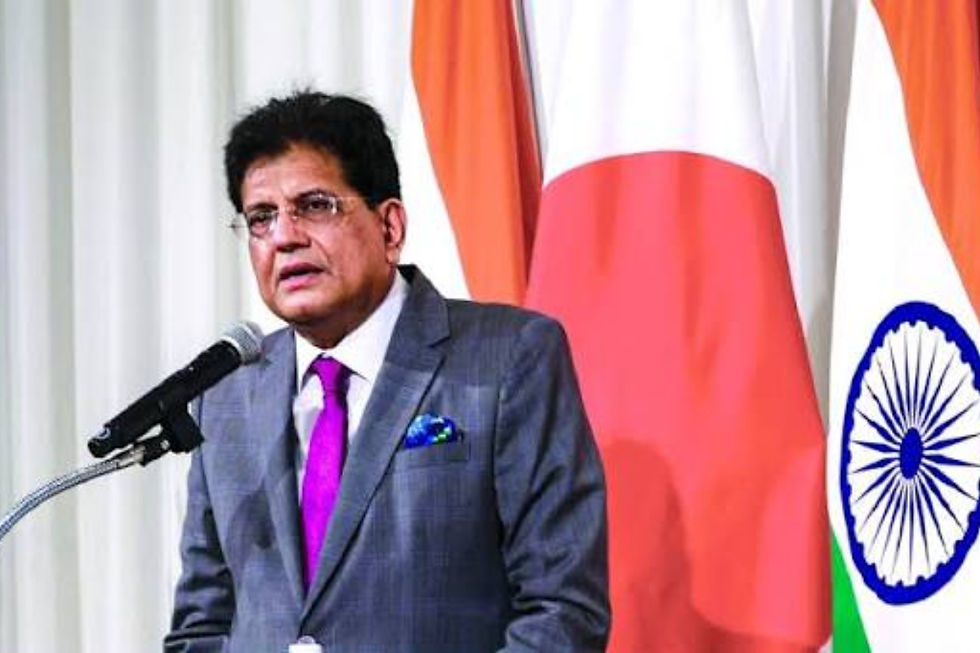
A month later, Commerce Minister Piyush Goyal carried that mandate to Tokyo, Nagoya and Osaka, telling industry the CEPA had to get "more contemporary." Behind the diplomatic language sits a blunter number: India's trade deficit with Japan.
The Tracker:
Date | Development | Status |
1 August 2011 | CEPA signed (Feb 2011) and enters into force | Completed |
2 March 2026 | 7th India–Japan CEPA Joint Committee Meeting, Tokyo | Completed |
July 2026 | 16th Annual Summit, New Delhi; leaders agree to accelerate the review | Completed |
24–27 Aug 2026 | Goyal's Tokyo–Nagoya–Osaka visit; CEPA, semiconductors and AI on the table | Completed |
August 2026 | India signals push for basmati rice and processed-food market access | Ongoing |
Next phase | Further review rounds, sectoral subcommittee talks | Watch |
India–Japan CEPA Review 2026: At A Glance
Signed in February 2011, the agreement covers goods, services, investment, movement of professionals, IP, customs and a phased tariff-reduction schedule. Seven subcommittees run underneath it, rules of origin, customs, technical standards, services, business environment and professional mobility among them. All of that was designed for a 2011 economy. It says nothing about semiconductors, AI or the supply-chain politics of 2026 which is exactly the gap this review is meant to close.
Strip away the diplomatic framing and India's case comes down to one word: imbalance.
At the March 2026 Joint Committee Meeting, India's Commerce Secretary pushed Japan on export potential in textiles, pharmaceuticals, agriculture and services, and called for "a more balanced bilateral trade relationship." Industry voices go further, pointing to Japanese SPS rules, registration hurdles and language barriers as the quiet reasons Indian generics, devices and professionals struggle to break in a claim worth flagging as industry's framing, not a settled fact.
Let's understand the gap. Bilateral trade hit US$27.47 billion in FY2025–26, per the Embassy of India in Tokyo but Japan's exports to India ran to $21.43 billion against just $6.04 billion the other way. That's a $15-billion-plus deficit, in a relationship that's grown steadily but stayed lopsided the whole time.
An ASSOCHAM report timed to Goyal's August visit put trade at roughly $20.58 billion in FY2021–22, rising to about $25.17 billion in FY2024–25 before hitting $27.47 billion which is a 33% climb in four years. Yet India's share of Japan's total imports is still under 1%. Growth, yes. Balance, not yet.
Talking Points:
Market access & goods — India wants more room in a market where it barely registers.
Agriculture & food — basmati rice and processed food are now a live test case (more below).
Services & professional mobility — flagged repeatedly since March 2026.
Pharma & textiles — named directly by India's Commerce Secretary as growth sectors.
Investment & tech — semiconductors and AI now sit alongside the tariff conversation.
Agriculture & Food: Basmati Rice
Rice is where the review gets political. In August 2026, Goyal said India would push Japan on basmati market access as part of the CEPA talks and flagged processed food as a bigger opportunity still. The catch is that Japan treats rice as a sensitive commodity, capping import volumes before duties kick in. Goyal called it a two-way ask, India gets a hearing, but Indian exporters have to clear Japan's strict quality and safety bar first. Nothing has been agreed. This is a stated goal, not a done deal.
Semiconductors and AI
While the tariff review moves at diplomatic pace, a parallel conversation is moving faster. At an August 2026 roundtable in Tokyo with 21 Japanese companies, Goyal called semiconductors and AI "central pillars" of the India-Japan economic security partnership, citing India's semiconductor demand climbing toward an estimated $150 billion by 2032. Japanese firms, for their part, reaffirmed backing for "Make in India" and "Design in India." This track isn't formally part of the CEPA review but it's happening on the same trip, with the same ministers, for the same reason.
The Investment Story Running Alongside
Trade isn't the only number that matters here. Japan set a target in August 2025 to mobilise ¥10 trillion (roughly $65–70 billion) in private investment into India over ten years — reaffirming an earlier ¥5 trillion goal that was hit ahead of schedule. By August 2026, Goyal said about 15% of the new target, over ₹1 lakh crore, had already landed. Cumulative Japanese FDI into India stands near $44.97 billion since 2000, making Japan the fifth-largest source. This is why the CEPA review isn't just an exporter's issue, it matters just as much to Japanese manufacturers already betting on India.
Parting Thoughts: What Comes Next with India-Japan CEPA?
Can a review turn 15 years of steady-but-lopsided trade into something more balanced? That's the real question, and nobody's answered it yet. It hinges on how far Japan bends on sensitive sectors like rice, how fast professional-mobility rules get unstuck, and whether the semiconductor-AI momentum feeds back into the trade text or just runs alongside it. Both governments are still talking about accelerating the process, not concluding it.
Watchlist: 2026–27
Next round of CEPA review talks and any timeline for it.
A possible dedicated Trade in Goods subcommittee.
Concrete movement on basmati rice and processed food.
Services and professional-mobility outcomes.
Rules-of-origin discussions.
New investment announcements against the ¥10 trillion target.
Follow-through on semiconductor and AI cooperation.
Any actual tariff concessions or textual amendments.
Frequently Asked Questions On India-Japan CEPA 2026
1) What is the India–Japan CEPA?
A comprehensive trade agreement in force since 1 August 2011, covering goods, services, investment, professional mobility, IP and customs.
2) Is this a new FTA?
No — it's a review and modernisation of the existing 2011 CEPA, not a fresh negotiation.
3) When did the CEPA come into force?
CEPA came into force on 1 August 2011.
4) Why is it being reviewed?
Both governments cite the 15-year gap since signing, and India is pushing to fix a persistent trade deficit.
5) What's the latest update?
August 2026: India and Japan agreed to accelerate the review, following the July 2026 summit and the March 2026 Joint Committee Meeting.
6) How big is bilateral trade?
About $27.47 billion in FY2025–26 — $6.04 billion in Indian exports against $21.43 billion in imports from Japan.
7) Which sectors stand to gain?
Textiles, pharma, agriculture/processed food and services — plus a parallel push on semiconductors and AI.
Sources: Ministry of Commerce and Industry (Government of India); Embassy of India, Tokyo; Ministry of Foreign Affairs, Japan; official statements by Union Commerce and Industry Minister Piyush Goyal, August–September 2026.


Comments