


Ties of Steel: The Expanding India–Japan Industrial Cooperation and its Global Relevance
Steel has long been more than just an industrial material for India and Japan. It has acted as a quiet and enduring bridge between the two countries. Over time, it has evolved from a basic trade component into a strategic partnership centred on modernization, sustainability and global industry shifts. Long before the term "strategic partnership”, steel- both as a became common, steel- both as a product and a symbol- was helping lay the economic and technological basis of India-Japan relations. Understanding the history reveals how early industrial cooperation moulded trust, mutual understanding, and shared goals that anchor this bilateral relationship today.

New Delhi. December 9. 2025
After independence, India’s decision to industrialize made it a natural partner and perfect market for Japan’s post-war industrial recovery. In the 1950s and 1960s, when India sought advanced technology and high-quality machinery for its public and private sector steel plants, Japan emerged as a key partner, sending engineers and industrial missions. Japan's technical support modernized Indian rolling mills, upgraded blast furnace designs, and improved metallurgical standards across Indian plants, even before large-scale trade was formalised.
The collaboration between Tata Steel and Japanese experts was one of the earliest and most influential (a joint venture between Tata Steel and the Japan-based Yodogawa Steels in 1968). Japanese methods of production introduced process discipline, which later became industry norms- setting the industrial undertone for a consistent, long-term, committed relationship. This flow was not unidirectional. Japan, with minimal iron ore reserves, relied heavily on imports to keep its steel industry globally competitive. From the late 1950s, India emerged as a significant supplier, exporting ore from Goa, Kiriburu (then in Orissa and Bihar), and Bailadilla (Madhya Pradesh). By 1960, India had become the top supplier of ore to Japan, playing a crucial role in resolving Japan’s raw material shortages and powering its steel boom. This two-way exchange shaped mutual interdependence between them.
India and Japan occupied different strategic positions during the Cold War, which sometimes limited top-level diplomatic interaction. Despite this, economic cooperation remained stable. Japanese firms continually delivered advanced steel-making equipment and highly efficient steel products, while Indian industries continued importing the machinery and expertise related to metallurgical fields. This continuity was instrumental in fostering the long-term familiarity between Indian and Japanese industries.
Steel and the Infrastructure Renaissance
The need for steel has become even more significant in the last twenty years. The Mumbai–Ahmedabad High-Speed Rail Project, the flagship symbol of India–Japan partnership in the field of infrastructure, uses top-grade, seismic-resistant Japanese steel and specialized steel-producing techniques. Japan is also providing ODA loans and advanced technology via Japan International Cooperation Agency (JICA) for metro rail systems, freight corridors and smart city projects. Most of these infrastructural innovations are also incorporating the steel related construction technologies pioneered in Japan. It shows that steel is more than just a material- it is the core that holds up some of the most transformative projects under this partnership.
Several major collaborations reflect this trajectory, such as:
· The formation of ArcelorMittal Nippon Steel joint venture, known as AM/NS India, in December 2019, following the acquisition of insolvent Essar Steel by the two major steel companies. Nippon Steel also entered a joint venture with TATA Steel, which produces high-grade steel used for automobiles. A group of companies, led by Mitsubishi Corporation and Larsen & Toubro, worked with Steel Authority of India Limited (SAIL) on modernising the Rourkela Steel Plant.
· Signing of the Memorandum of Cooperation between the Ministry of Steel, Government of India and the Ministry of Economy, Trade and Industry, Government of Japan, in December 2020. It led to the establishment of the India-Japan Steel Dialogue. It was attended and signed by Pradip Kumar Tripathi and Shigehiro Tanaka, Vice-Minister for International Affairs.
· Bilateral meeting held by Union Minister of Steel Jyotiraditya M. Scindia and Minister of Economy, Trade and Industry of Japan, Nishimura Yasutoshi, in New Delhi to discuss cooperation in the steel sector and decarbonisation issues. (July 2023)
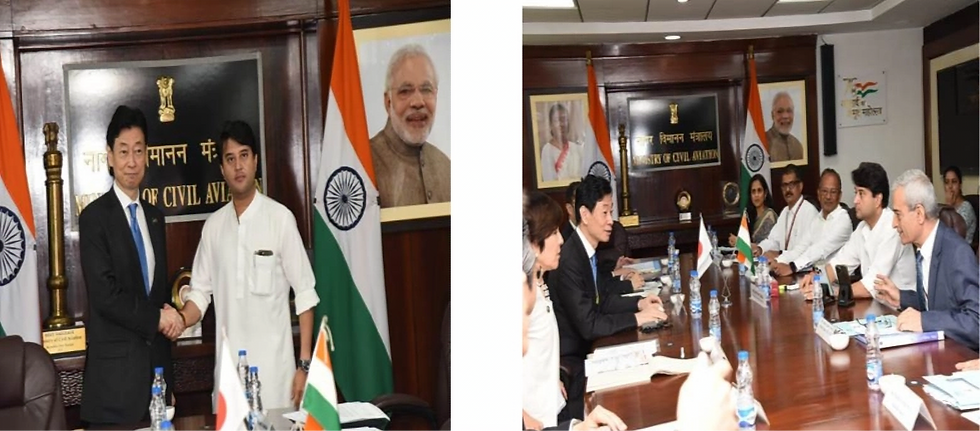
· The recent 3rd India-Japan Steel Dialogue was held in February 2025, at Vigyan Bhavan, New Delhi. It was organized by the Ministry of Economy, Trade and Industry (METI), Japan, and the Ministry of Steel, India. (co-chaired by Mr. Vinod Kumar Tripathi, Joint Secretary, Ministry of Steel, Government of India, and Hideyuki Urata, Deputy Director General, METI, Japan)

Recent Surge: Japanese Firms Investing Again in India
The two sides are further solidifying their cooperation in the steel industry. Recently, Aichi Steel Corporation of Japan, widely regarded as a steel arm of Toyota, informed that it would extend its collaboration with Vardhman Special Steels in Punjab, with an estimated investment of ₹500 crore. The signing of the Memorandum of Understanding (MoU) took place in the presence of the Chief Minister of the state, Bhagwant Singh Mann, on his visit to Japan. This signals that Japan is looking at the Indian manufacturing and infrastructure sectors as industries that will continue to grow.

Similarly, the newly minted partnership between India's JSW Steel (the second-largest private steel producer) and JFE Steel Corporation (Japan’s second-largest alloy-maker) is another case in point. On 4 December 2025, the two companies set up a major cooperation under which JFE will take a 50% stake in the integrated steel business of Bhushan Power & Steel Limited (BPSL), for ₹15,750 crore. The joint venture plans not only to double the plant's capacity for crude steel production to 10 million tons annually but also to shift the focus from quantity to quality through value-added steel products. This investment demonstrates Japan’s commitment to supporting India’s steel capacity expansion, upgrading technology and making the supply chain more robust.
Looking Ahead: Green Steel, Next Industrial Frontier and the Global Market
The next chapter of the India-Japan steel cooperation story will likely revolve around ecological concerns. Both countries have committed to carbon neutrality, collaborating on green steel, hydrogen-based metallurgy, and low-emission manufacturing. Japan’s lead in hydrogen reduction methods, recycling technologies, and energy-efficient processes can help India speed up its path to a clean industrial ecosystem. At the same time, India’s growing market, youthful workforce and expanding manufacturing base position it as an ideal partner for Japan’s diversification under supply-chain initiatives. As global supply chains are reconfigured and sustainability becomes central, steel once again stands at the heart of Indo-Pacific cooperation.
Top 3 countries in terms of Global Crude Steel Production (in Million Tonnes)

Source: World Steel Association, Worldsteel.org
As reflected in the table above, India and Japan stand as the world’s second and third-largest steel producers. However, the combined scale of their production still falls far below China’s output. In 2024, China produced 1005.1 million tonnes, whereas India and Japan together produced 233.6 million tonnes. This means:
China produces over 4× the combined output of India and Japan.
China’s production is 6.7× larger than India’s and nearly 12× larger than Japan’s.
China alone accounts for 55% of global steel production, shaping prices, supply chains, and industrial demand patterns.
These differences are a reflection of China's advantages: huge domestic demand due to rapid urbanisation, strong state-backed industrial expansion, vertically integrated supply chains and secure access to overseas raw materials. These factors have allowed China to have unparalleled economies of scale and a great deal of power over global steel pricing.
The two countries, India and Japan, however, have the potential to develop complementary strengths that will enable them to be in a strong position to counterbalance this. India’s growing steel capacity, large market, and growing infrastructure needs provide scale, whereas Japan’s proficiency in high-grade, precision, and automotive steel is the technological edge. As a result, India’s volume and resources, merged with Japan’s quality and innovation, can make the steel sector more resilient in the Indo-Pacific region.
As global demand for specialised, high-strength, and green steel is increasing, a deeper India-Japan collaboration is both timely and necessary. The two countries are already on the same wavelength, as evidenced by recent developments, the JSW–JFE partnership and Aichi Steel’s investment expansion in India. While China continues to hold the dominant position, closer India-Japan coordination is very crucial for competitive growth as well as for the establishment of stable, sustainable, and diversified regional supply chains.
About the Author
Kaveri Jain is a doctoral researcher in International Relations at the Amity Institute of International Studies, Amity University, Noida. Her work focuses on India-Japan relations during the Shinzo Abe era. She has presented at academic conferences, published in peer-reviewed platforms and written on various aspects of India-Japan ties, including foreign policy, technology cooperation, cultural exchange, diaspora diplomacy and engagement in the Indo-Pacific region.


Comments