


Silk of Trust, Steel of Strategy: What Really Changed During Prime Sanae Minister Takaichi's India Visit?

The agreements reached during the summit certainly matter. More than 10 trillion yen in prospective investment, expanded defence cooperation, collaboration in artificial intelligence, semiconductors, clean energy, resilient supply chains and advanced manufacturing all point towards a partnership of growing tactical depth. But the larger story lies beyond the numbers.

The real story of Prime Minister Sanae Takaichi's visit to India isn't about one head of government meeting another. It is about two societies deciding to dream together.
In an age when alliances are predominantly measured by military hardware, trade balances or tactical calculations, something quieter unfolded in New Delhi this week. It was visible not merely in the agreements that were signed but in the confidence with which two Asian democracies spoke about their future. India and Japan were no longer discussing what they could do for one another. Instead, they were discussing what they could build together and that distinction matters.
As the world fragments into competing blocs, with supply chains becoming geopolitical weapons and technology emerging as the new currency of power, countries are discovering that trust is becoming as valuable as capability. India and Japan appear to have recognised this reality earlier than many others. Prime Minister Sanae Takaichi's maiden visit to India produced a comprehensive roadmap that reflects confidence across defence, advanced technology, economic security, manufacturing, clean energy, resilient supply chains and cultural exchange.
The sixteenth India-Japan Annual Summit marked a quiet but unmistakable transition. The relationship has moved beyond the familiar narrative of Japanese investment supporting Indian development. It is now evolving into one of the Indo-Pacific's most consequential strategic partnerships, where both nations increasingly see each other as indispensable partners in navigating an uncertain global order.
Basking in the Warmth of India-Japan Diplomacy
Diplomacy is usually choreographed with remarkable precision. Every word is measured. Every gesture is calculated. Yet some moments resist protocol because they reveal something more authentic than official communiqués ever can.
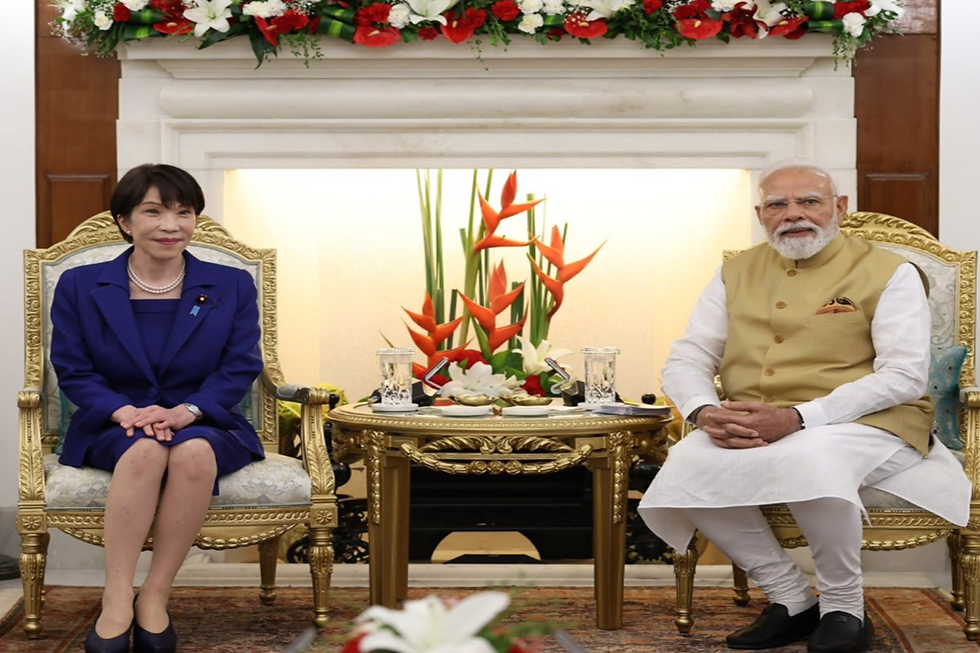
Prime Minister Narendra Modi's decision to affectionately refer to Prime Minister Sanae Takaichi as his "younger sister" during the joint press statement was one such moment featuring an unusual departure from diplomatic convention, and perfectly capturing the warmth that has gradually come to define India-Japan relations. Before the bilateral talks even began, Takaichi offered another symbolic gesture by bowing before the national flags of both countries, reflecting the respect that continues to underpin the relationship.
For many, such gestures appear like fleeting moments. They were anything but. These breaks from protocol reflected a partnership that has steadily accumulated political trust over decades. That trust was evident throughout the summit as the two leaders reviewed virtually every dimension of bilateral engagement, from infrastructure and trade to maritime security, innovation, education, pharmaceuticals, supply chains and regional stability. Foreign Secretary Vikram Misri aptly described the visit as another significant milestone in strengthening the India-Japan Special Strategic and Global Partnership.
The private dinner hosted by Prime Minister Modi after the formal engagements only reinforced what the official meetings had already conveyed. Strategic partnerships are ultimately sustained not by documents alone but by relationships capable of weathering changing governments, economic cycles and geopolitical uncertainty.
Harvesting Technology and Building Trust
If economics once formed the backbone of India-Japan relations, technology became its soul. Prime Minister Modi described technology cooperation as the strongest pillar of the partnership in the years ahead. That statement was more than political optimism because it reflected the changing realities of international competition, where leadership in artificial intelligence, quantum computing, biotechnology and advanced manufacturing overwhelmingly determines national influence.
The summit's Joint Statement on Artificial Intelligence illustrated how both countries are attempting to shape, rather than merely respond to, technological transformation. Their emphasis extends beyond commercial cooperation into responsible AI development, research partnerships, innovation ecosystems and the governance of emerging technologies.
Several Indian institutions working in artificial intelligence also signed agreements with Japanese counterparts, creating pathways for deeper collaboration in research and innovation. Alongside AI, both governments committed themselves to expanding cooperation in semiconductors, critical minerals, pharmaceuticals, aerospace and next-generation manufacturing.
Around the world, governments are scrambling to secure access to semiconductor technologies, critical raw materials and advanced manufacturing capabilities. Technology has indeed become an instrument of national resilience. India brings one of the world's fastest-growing digital ecosystems and a vast talent pool. Japan contributes decades of excellence in precision engineering, manufacturing and industrial innovation. Today, both countries see these strengths not as separate assets but as complementary capabilities.
Business leaders echoed precisely this sentiment during the India-Japan Joint Economic Forum. Haruyuki Hiratani, CEO and CCO of Future Creation Company, observed that Japan's expertise in mechanical engineering combines naturally with India's leadership in information technology, creating significant opportunities in Internet of Things solutions and advanced manufacturing.
From Factory Floors to Supply Chains
Economic cooperation remained the summit's most visible pillar, but even here the conversation has evolved. For decades, Japanese investment has transformed India's manufacturing landscape. Today, the objective is no longer simply attracting capital but jointly creating resilient industrial ecosystems capable of serving global markets.
Addressing the India-Japan Joint Economic Forum, Prime Minister Modi described bilateral economic ties as "very special." His example was telling. Nearly two-thirds of Suzuki vehicles sold worldwide are manufactured in India before being exported to more than a hundred countries. What generations across India have witnessed as an industrial collaboration has today evolved into a model of integrated global production. That remarkable success story now provides the template for the next generation of India-Japan cooperation.
Despite persistent uncertainty across the international economy, supply chain disruptions and slowing global demand, India continues to project itself as the world's fastest-growing major economy, recording GDP growth of 7.7 per cent during the previous financial year. Prime Minister Modi also credited the Japanese philosophy of Kaizen, adopted across various sectors over the past twelve years, with helping reshape both manufacturing practices and governance reforms.
The ambition announced during the summit reflects confidence rather than caution. India and Japan intend to attract more than 10 trillion yen of Japanese investment over the coming decade while doubling the number of Japanese companies operating in India. Shipbuilding, mobility, defence manufacturing, clean energy and advanced industrial technologies have all emerged as priority sectors.

These are not incremental adjustments as they represent an attempt to redesign the architecture of economic cooperation for an era defined by cut-throat competition. The symbolism became even stronger with the joint virtual inauguration of Maruti Suzuki India's fourth automobile manufacturing facility at Kharkhoda in Haryana.
The numbers alone tell an impressive story. Maruti Suzuki's cumulative investment across its four Indian manufacturing plants now stands at nearly INR 35,000 crore. Once the Kharkhoda facility reaches full capacity, it will produce ten lakh passenger vehicles annually, reinforcing India's emergence as a global automobile manufacturing hub.
For more than four decades, Maruti Suzuki has demonstrated that long-term partnerships flourish when foreign investment aligns with domestic capability. It has generated employment, strengthened ancillary industries, expanded supply chains and steadily embedded Japanese manufacturing excellence within India's industrial ecosystem. That experience now serves as a blueprint for the broader India-Japan partnership.
Security in an Uncertain World
Every enduring partnership is eventually tested not by prosperity but by uncertainty. The India-Japan relationship is reaching precisely that moment.
The Indo-Pacific has become the principal theatre of twenty-first-century geopolitics. Maritime disputes continue to simmer. Economic coercion has become an accepted instrument of statecraft. Critical technologies are largely subject to export controls, while supply chains that once symbolised globalisation now expose severe vulnerabilities. Against this backdrop, India and Japan are discovering that their partnership is becoming indispensable.
Prime Minister Modi welcomed Japan's decision to review its three principles governing the transfer of defence equipment and technology, describing it as an important step towards expanding bilateral defence cooperation. Although Japan has traditionally maintained a cautious approach to defence exports, the evolving regional security environment has prompted Tokyo to reconsider long-standing assumptions. India stands to become one of the most trusted beneficiaries of that tactical recalibration.
The two leaders also reaffirmed their commitment to implementing the Joint Declaration on Security Cooperation and directed their Defence and Foreign Ministers to convene the fourth India-Japan 2+2 Ministerial Meeting in Tokyo before the end of the year. The instruction reflected a growing urgency to translate political intent into institutional momentum.
Progress on the Unified Complex Radio Antenna, or UNICORN, project further illustrated this shift. Agreement in principle on the remaining technical aspects cleared the way for its early implementation, signalling that defence collaboration is moving beyond dialogue towards tangible capability-building.
Military cooperation is also becoming operational. Both countries welcomed the successful conduct of JAIMEX 25 and acknowledged Japan's participation in the International Fleet Review 2026 at Visakhapatnam. Maritime domain awareness, naval exercises, Maintenance, Repair and Overhaul facilities, satellite-enabled surveillance and defence manufacturing under the Make in India initiative all featured prominently in the discussions.
Collectively, these initiatives suggest that India and Japan are gradually constructing the infrastructure required to preserve stability across one of the world's most contested regions.
Economic Security Becomes National Security
If the pandemic exposed the fragility of global supply chains, the years that followed demonstrated how easily economics could become an instrument of geopolitical competition. Few countries understand this better than India and Japan.
The summit therefore devoted considerable attention to economic security, recognising that resilience today depends as much on trusted partners as on domestic capability. The adoption of Economic Security Factsheet 2.0 reflected this shared understanding. Cooperation will expand across strategic crude oil reserves, maritime energy transportation and resilient supply chains designed to reduce dependence on vulnerable chokepoints.
Japanese Press Secretary Toshihiro Kitamura noted that both nations face common challenges arising from restrictions on critical imports and dual-use technologies. Rather than responding defensively, India and Japan have identified five priority areas for collaborative projects that strengthen secure and reliable supply chains.
Energy security occupied an equally central place in the conversations. Prime Minister Takaichi observed that the world is entering an era shaped by protectionism, economic coercion and rising geopolitical tensions. Her vision of "Growing Stronger and More Prosperous Together" resonated closely with Prime Minister Modi's MAHASAGAR initiative, which similarly seeks to foster stability, resilience and inclusive growth across the maritime neighbourhood.
The emphasis on clean energy demonstrated that this partnership is looking well beyond immediate geopolitical challenges. Agreements on green hydrogen between ACME Cleantech and Japanese companies signalled growing confidence in future energy technologies. Plans to establish one thousand biogas plants across India using Japanese expertise further expanded the scope of cooperation. Industry leaders also highlighted electric mobility, battery storage and hydrogen ecosystems as sectors capable of defining the next phase of bilateral investment.
The significance of these initiatives extends beyond environmental sustainability. Nations that lead the clean energy transition will shape the economic architecture of the decades ahead. India and Japan appear determined not merely to participate in that transformation but to influence its direction.
An Indo-Pacific Vision Rooted in Shared Values
Strategic partnerships often survive because interests converge. The strongest ones endure because values do. That deeper alignment was evident in the conversations surrounding the Indo-Pacific.
Prime Minister Takaichi described India as an indispensable partner in advancing Japan's vision of a Free and Open Indo-Pacific. Prime Minister Modi, in turn, emphasised that India's MAHASAGAR initiative pursues the same objective of ensuring a free, secure, inclusive and prosperous maritime region.
Both countries depend heavily on secure sea lanes for trade and energy supplies. Both seek a rules-based international order that protects freedom of navigation and peaceful dispute resolution. Both remain committed to an Indo-Pacific where no single power dominates regional decision-making.
The Quad naturally figured in these discussions. India and Japan reaffirmed cooperation with fellow Quad partners across maritime security, humanitarian assistance, disaster relief, emerging technologies, critical minerals and economic resilience. Unlike traditional military alliances, the Quad reflects a broader understanding of security, one that recognises technology, infrastructure, health, climate resilience and trusted supply chains as equally important pillars of regional stability.
For India and Japan, the Indo-Pacific is a vision built upon openness, connectivity and mutual respect.
Where Ancient Civilisations Meet Artificial Intelligence
Perhaps the most remarkable aspect of Prime Minister Takaichi's visit was its extraordinary breadth. One announcement celebrated the shared Buddhist heritage connecting India and Japan across two millennia. Another advanced cooperation in biotechnology, artificial intelligence and large language models. Few bilateral relationships can comfortably span such vast stretches of history while simultaneously exploring the frontiers of technological innovation.
Such a unique combination gives the partnership a distinctive character. Recognising that vital relationships ultimately depend on public support, both governments announced that 2027 would be celebrated as the India-Japan Year of Shared Horizons, commemorating seventy-five years of diplomatic relations. The anniversary programme deliberately looks beyond government corridors.
Ten commemorative events will place particular emphasis on youth participation and cultural exchange. India-Japan Week will be observed on April 28, 2027, accompanied by nationwide logo and theme competitions inviting citizens to imagine the future of bilateral ties. The initiatives are refreshingly imaginative.
IMAGE-75 will promote collaboration in manga, anime, gaming, animation and immersive technologies, acknowledging the growing influence of Japanese popular culture among young Indians. RASA-75 will celebrate performing arts, visual arts and traditional cultural exchanges, while SPORT-75 will strengthen sporting links between the two countries.
Cricket, perhaps unexpectedly, will also become part of the diplomatic vocabulary. An India-Japan Friendship Cricket Match is planned during the Aichi-Nagoya Asian Games 2026, while the Cricket Kizuna-75 initiative will see Indian coaches train aspiring Japanese cricketers.
The celebrations will also honour the civilisational links that have effortlessly connected both societies for centuries. A Japanese Buddhist delegation will visit important pilgrimage sites across India, reinforcing a cultural bridge that predates modern diplomacy by nearly two thousand years.
16 Landmark Outcomes of Prime Minister Sanae Takaichi's Visit

Sixteen agreements that turned this inconspicuous state visit into a tactical milestone:
1. India-Japan Joint Declaration on Economic Security: Strengthens cooperation in semiconductors, critical minerals, AI, ICT, clean energy and pharmaceuticals while promoting resilient supply chains, institutional partnerships and faster implementation of strategic projects.
2. Joint Statement on Cooperation in Artificial Intelligence: Establishes a framework for resilient AI infrastructure, industry-academia collaboration, joint research, talent mobility and human-resource exchanges across the AI ecosystem.
3. Joint Statement on Energy Resilience: Enhances India's energy security through petroleum reserves, joint investments in maritime energy transportation and stronger cooperation on resilient energy supply chains.
4. India-Japan Year of Shared Horizons (2027): Marks the 75th anniversary of diplomatic relations with year-long programmes involving youth, businesses, scholars, artists, sportspersons and cultural exchanges.
5. Memorandum of Cooperation on Batteries: Accelerates India's battery manufacturing and electric vehicle ecosystem by promoting trusted supply chains, Japanese investment and technology collaboration.
6. Memorandum of Cooperation on Pharmaceuticals and Medical Devices: Expands collaboration in pharmaceutical research, medical devices, capacity building, business partnerships, joint ventures and resilient API supply chains.
7. Memorandum of Cooperation on Geology and Mineral Exploration: Advances joint exploration of critical minerals, geological research and technical cooperation to strengthen India's long-term resource security.
8. India-Japan Cooperative Biogas for Growth (CBG) Initiative: Promotes cooperative-led biogas projects, organic fertiliser production, carbon-credit generation, research and scalable rural clean-energy models.
9. IIT Bombay–BharatGen Technology Foundation–National Institute of Informatics (Japan) MoU: Strengthens India's large language model (LLM) and AI research ecosystem through collaborative research and researcher and student exchanges.
10. IndiaAI Mission–METI Japan MoU: Creates direct linkages between Indian and Japanese AI ecosystems by supporting startups, skills development, internships and technology collaboration.
11. RIKEN–C-CAMP MoU: Expands India-Japan cooperation in biotechnology, life sciences and deep-tech while promoting joint research, innovation and startup development in healthcare, agriculture and environmental sciences.
12. Exchange of Letters between IFSCA and JFSA: Enhances regulatory cooperation in fintech and regtech, strengthens India's international financial services ecosystem and facilitates the exchange of regulatory best practices.
13. NIXI–JPNIC MoU: Deepens cooperation in internet infrastructure, internet governance, IPv6 adoption, cybersecurity practices and capacity building in internet registry operations.
14. SarvamAI–Preferred Networks MoU: Encourages private-sector collaboration in artificial intelligence through joint LLM development, product innovation and new market opportunities.
15. Memorandum of Cooperation on Next-Generation Mobility Partnership: Promotes cleaner, technology-driven transport systems, advanced mobility infrastructure, technical training and positions India as a manufacturing and export hub under the 'Make in India for the World' initiative.
16. RIKEN–NCBS-TIFR MoU: Strengthens scientific collaboration in biological sciences, including regenerative biology, neuroscience and biophysics, while facilitating exchanges among researchers, faculty and doctoral students.
A Blueprint for Asia's Future
If Prime Minister Takaichi's India visit revealed anything, it is that India and Japan have stopped preparing for the future. They have begun building it together.
The agreements reached during the summit certainly matter. More than 10 trillion yen in prospective investment, expanded defence cooperation, collaboration in artificial intelligence, semiconductors, clean energy, resilient supply chains and advanced manufacturing all point towards a partnership of growing tactical depth. But the larger story lies beyond the numbers.
In a world visibly divided by suspicion, India and Japan are choosing to invest in trust. At a time when many nations are responding to geopolitical uncertainty by retreating behind narrower definitions of national interest, these two democracies are attempting something more ambitious. They are building resilience through openness, security through cooperation and prosperity through shared innovation.
The symbolism of the visit captured that evolution perfectly. One moment reflected personal warmth between two leaders. Another unveiled ambitious plans in artificial intelligence and critical technologies. A third celebrated centuries-old Buddhist connections that continue to shape cultural memory. Together, they formed a narrative that few bilateral relationships can genuinely claim.
Years from now, Prime Minister Sanae Takaichi's first visit to India may well be remembered not as another successful summit, but as the moment two Asian powers quietly decided that the future of the Indo-Pacific would be stronger if they wrote it together.


Comments