


The Evolving Promise of the Maharashtra-Wakayama Partnership
The relationship between India and Japan has often been described as one of the most natural partnerships in the Indo-Pacific. A bond that is rooted in shared democratic values, a commitment to a rules-based order, and most importantly, a deep-seated spiritual heritage. Within this macro-framework of national diplomacy, the "Sister State" relationship between the Indian state of Maharashtra and Japan’s Wakayama Prefecture stands out as another unique model of sub-national cooperation.
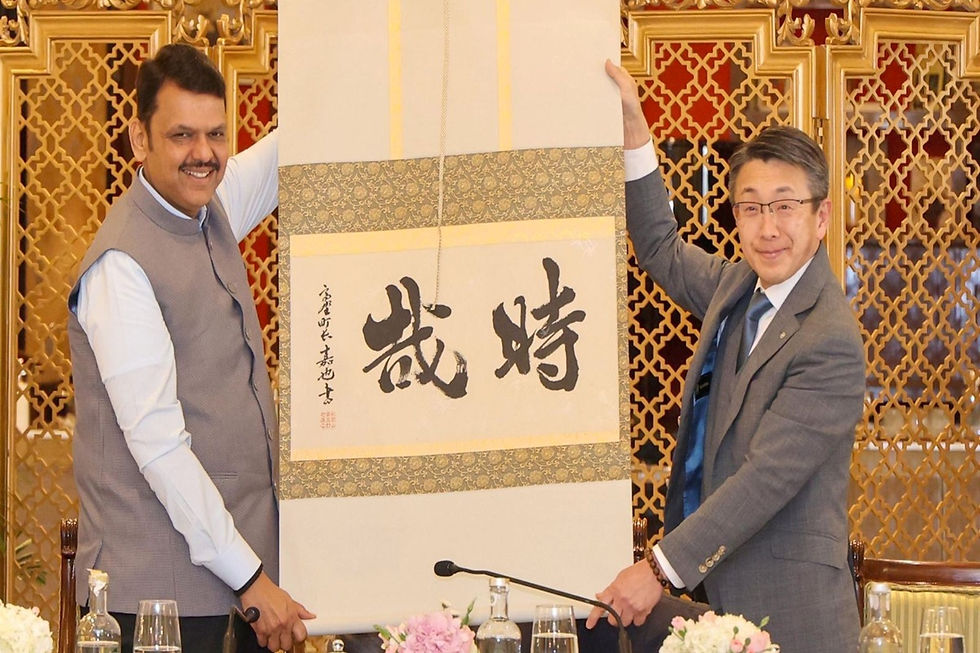
On 13 February 2026, at the iconic Taj Mahal Palace in Mumbai, this partnership reached a new milestone. Chief Minister Devendra Fadnavis hosted a high-level Japanese delegation led by Wakayama Governor Izumi Miyazaki. This meeting was a reaffirmation of a decade-long journey that began in 2013 (sister-state relationship) and which was renewed with fresh vigour in 2023.

The decade-long synergy is anchored by more than just trade. It is a granular, operational partnership. From 2013 to the 2023 renewal, the relationship has pioneered 'Wrestling Diplomacy' (sumo wrestlers visiting Mumbai, training in Pune and demonstrations at the Gateway of India), bridging Maharashtra’s Kusti with Japan’s Sumo, and knowledge sharing in an institutionalized manner. This also includes Omotenashi hospitality training for Indian tourism officials and academic tie-ups between Koyasan University and Dr. Babasaheb Ambedkar University. With dedicated representative offices in both Mumbai and Tokyo, the alliance has moved beyond diplomacy into a practical framework for civic and educational exchange.
A Legacy of Spiritual Connectivity
To understand the warmth between Maharashtra and Wakayama, one must look beyond trade balance sheets and toward the spiritual geography that links them. For the Japanese, Mt. Koya (Koyasan) in Wakayama is the sacred heart of Shingon Buddhism. For Maharashtra, the city of Nagpur is the epicentre of a modern Buddhist revival, being the site where Dr. B.R. Ambedkar led millions to the faith in 1956. The Chief Minister’s address highlighted this connection. He recalled the installation of a statue of Dr. Ambedkar at Koyasan University- a gesture that resonated deeply with the people of Maharashtra. In a significant cultural proposal, CM Fadnavis suggested the installation of a replica of the Bamiyan Buddha statues in Nagpur. This move (marking the 25 years since the tragic destruction of the original statues in Afghanistan) is intended to serve as a global beacon of peace. Both regions are framing their economic partnership within a broader context of humanistic values by rooting the Maharashtra-Wakayama friendship in the preservation of Buddhist heritage.
The Economic Frontier: Beyond the "Sister State" Label
While the spiritual bond provides the foundation, the architecture of the relationship is increasingly built on industrial and technological collaboration. Maharashtra, often called the " Economic Powerhouse of India," contributes roughly 14% of India’s GDP. Mumbai, its capital, is the nation's financial and entertainment nerve centre. CM Fadnavis emphasized during the meeting that the coming years will see an intensified focus on technology, manufacturing and service sectors. For Wakayama, a prefecture known for its precision manufacturing and agricultural innovation, Maharashtra offers a massive market and a growing talent pool. The presence of high-ranking officials like Maharashtra Legislative Assembly Speaker Rahul Narwekar and Consul General of Japan in Mumbai Yagi Koji underscores the political will to bridge the gap between Japanese efficiency and Indian scale.
The collaboration is already bearing fruit in the "soft" sectors. Tourism, sports and education have seen consistent exchange programs over the last decade. However, the next phase aims higher. It involves integrating Japanese "Monozukuri" (the art of making things) with India’s "Make in India" initiative. By fostering a climate where Japanese SMEs (Small and Medium Enterprises) from Wakayama can easily set up shop in Maharashtra’s industrial clusters, the partnership is moving toward a more integrated economic ecosystem.
The Human Element of Diplomacy
What makes the Maharashtra-Wakayama bond distinct is its "humanized" approach to diplomacy. It is about the exchange of students, the sharing of sporting techniques and the mutual respect for each other's historical struggles. The meeting at the Taj Mahal Palace was attended by representatives from across the spectrum, including legislators, cultural icons and industrial leaders. This multi-stakeholder approach ensures that the partnership isn't top-heavy. When Governor Miyazaki and Vice Speaker Akizuki Fuminari engage with their counterparts in Mumbai, they are building a bridge that supports everything from high-tech manufacturing to the promotion of Maharashtra’s tourist circuits among Japanese travellers. CM Fadnavis’s personal investment in this relationship is quite evident. Having visited Wakayama and Koyasan himself, his rhetoric carries the weight of personal experience. He views Japan not just as a source of Foreign Direct Investment (FDI) but as a developmental mentor.
Looking Ahead: A Global Message of Peace
The proposal to recreate the Bamiyan Buddhas in Nagpur is perhaps the most symbolic takeaway from this latest meeting. In times defined by geopolitical friction, the collaboration between an Indian state and a Japanese prefecture to honour a lost piece of world heritage is a powerful statement. It suggests that economic growth and technological advancement need not come at the cost of cultural memory.
The partnership between Maharashtra and Wakayama proves that when two regions find common ground in their history and a shared vision for their industrial future, the results transcend mere commerce. In the meeting, Governor Miyazaki also expressed his intent to renew the cooperation agreement in 2028 in order to expand collaboration, describing Wakayama as a gateway for Maharashtra in Japan. The "long-standing friendly relations" CM Fadnavis spoke of is a reality that is crafting a narrative of mutual prosperity- from the industrial corridors of Pune and Mumbai to the serene temples of Koyasan. In the coming years, as technology and services further entwine these two regions, it can be said that the world will see a partnership that is uniquely Asian in its soul and global in its impact.
About the Author
Kaveri Jain is a doctoral researcher in International Relations at the Amity Institute of International Studies, Amity University, Noida. Her work focuses on India-Japan relations during the Shinzo Abe era. She has presented at academic conferences, published in peer-reviewed platforms and written on various aspects of India-Japan ties, including foreign policy, technology cooperation, cultural exchange, diaspora diplomacy and engagement in the Indo-Pacific region.


Comments