


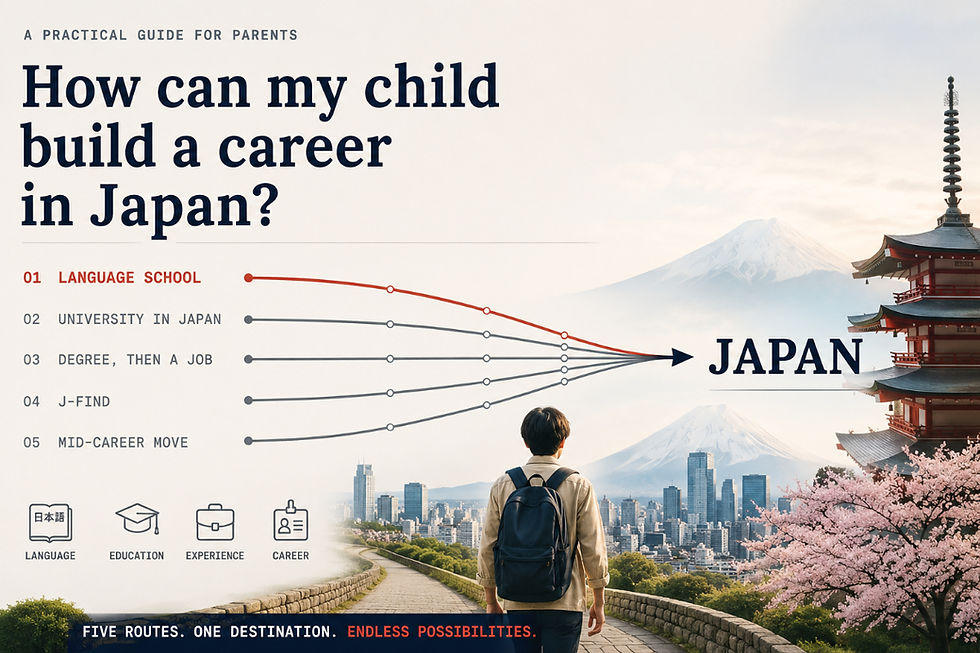
So Many Parents Keep Asking the Same Question: How Can My Child Build a Career in Japan? Here's My Practical Guide. How Indian Students Can Study and Work in Japan: 5 Routes Explained by Anil Raj.
For Indian families considering Japan, the path to study and work has never been clearer. How Indian Students Can Study and Build a Career in Japan: 5 Routes Explained is well explained by Anil Raj in his article.
By Anil Raj

I get this question almost every week now. Sometimes after an event in Tokyo, sometimes on WhatsApp from India, sometimes from a friend of a friend who heard I have been here a long time. The wording changes but the substance never does. My son is fascinated by Japan. My daughter wants to study here. We don't know where to begin. I have answered it in pieces for years, usually in a hurry, usually incompletely. So here is the whole thing in one place.
One caveat before we start. I am not an immigration lawyer. What I have is twenty-eight years of living and building businesses here, and a number of young people I have watched come through each of the routes below. Rules do change. I have written this to reflect where things stand in 2026, but please confirm the details with the Immigration Services Agency, a qualified immigration specialist, or the Embassy of Japan before anyone acts on it.
Start with the good news
Japan wants young international talent, and the system has been rebuilt to say so.
There are now more than 300 English-taught degree programmes at Japanese universities. The famous names are on that list, including the University of Tokyo, Waseda and Kyushu. So are private universities that have built English tracks specifically to bring international students in, among them Toyo University and Shibaura Institute of Technology. It is worth looking past the obvious names. The education ministry sets a standard annual tuition of ¥535,800 for national universities, plus a one-off admission fee of around ¥282,000. That is remarkably little for the quality on offer. Do check the figure for the specific university, though: institutions are allowed to charge up to 20% above the standard rate and a few now do, the University of Tokyo among them at ¥642,960.
Graduates also get time to look for work rather than being asked to leave the moment they finish.
The direction of policy is clear enough from one number. Japan set itself a target of 400,000 international students by 2033, and passed it eight years early, reaching 435,200 by June 2025. So the door is open. What the country asks for in return is preparation, and preparation is where a parent can be genuinely useful.
Route 1: Japanese language school first
Best for: a school-leaver with real interest but no Japanese yet. This is also the route I recommend most often, and the one I would choose myself.
A student visa covers Japanese language institutes, and one to two years of full-time language study is the most common way in. Tuition in Tokyo runs roughly ¥660,000 to ¥900,000 a year, with registration and materials fees on top. With the correct permission, students can work part-time up to 28 hours a week. That helps with living costs, but the bigger benefit is being dropped into real Japanese conversation from the first month.
My reason for favouring this route has less to do with the visa than with timing. Coming to Japan early, before a career has taken shape, changes how fast a person absorbs the place. The language goes in quicker at that age, and so does everything around it: how a workplace is run, how people speak to each other, what is expected and what is left unsaid. Someone who arrives at twenty-two learns the culture the way you learn a language, by being surrounded by it. Someone who arrives at thirty-five with a job, a title and a family is usually learning it from the outside, in the gaps between commitments. Both can work. The first is easier, and the head start compounds for the rest of a career here.
Here is the part people miss. Language school is a bridge, not a destination. It is built to lead into a university or a vocational college (専門学校). The post-graduation job-hunting extension I describe further down is generally available to graduates of universities and vocational colleges, and not to someone who has completed only a language school. Plan the second step before you commit to the first.
Route 2: A degree at a Japanese university
Best for: a student at eighteen who already has some Japanese, or who is ready to take an English-taught programme. It pairs naturally with Route 1 as the second step.
Four years here produces a graduate who speaks the language, understands how a Japanese workplace actually runs, and has access to the university career centres that drive most hiring. Employers read that profile very differently from an application arriving from overseas.
For Indian families the MEXT scholarship is worth taking seriously. It covers tuition in full, return airfare, and a monthly stipend: ¥117,000 on the undergraduate track, and ¥143,000 to ¥145,000 for master's and doctoral students. The undergraduate track is open to students under 25 and includes a preparatory year of Japanese before the degree itself starts, which is exactly what a school-leaver with no Japanese needs.
There are two ways to apply. The Embassy Recommendation route runs through the Embassy of Japan in New Delhi and the Consulates-General in Mumbai, Chennai, Kolkata and Bengaluru. Applications typically open in April with a deadline in May, roughly a year before enrolment. The University Recommendation route goes directly through the Japanese university you are targeting. It is competitive. It is also a genuine full scholarship, and Indian students win it every year.
Even without a scholarship the arithmetic is unusual. Standard national university tuition plus a part-time job makes Japan one of the more affordable serious study destinations anywhere.
Route 3: A degree at home, then a job here
Best for: a student already enrolled in India or elsewhere.
The standard work visa is the Engineer / Specialist in Humanities / International Services status, which is what most foreign professionals in Japan hold. It needs a relevant degree and a job offer. And one detail catches families out: the field of the degree has to match the work. A computer science graduate can take an engineering role. The same graduate cannot easily take a marketing role. Choose the course with the intended job already in mind.
There is an important update this year. Since 15 April 2026, applications filed by smaller sponsoring companies for roles that are primarily language-facing (interpretation, translation, customer service, sales that depends on communication) require proof of Japanese at CEFR B2, equivalent to JLPT N2. Applications through large listed corporations are not affected, and technical roles such as software engineering are largely untouched.
I read this as a signal rather than an obstacle. Japan is saying that language ability is what turns a foreign hire into a colleague. Anyone who starts learning early is simply ahead of it. The young people I see thriving here are almost always the ones who took the language seriously before they had to.
Route 4: J-Find, for graduates of highly ranked universities
Best for: a recent graduate of a globally top-ranked university who would rather arrive first and find the job afterwards.
J-Find gives eligible graduates up to two years in Japan to job-hunt or prepare to start a business, granted in six-month or one-year periods, with limited paid work allowed to support themselves. The applicant must be 18 or over, hold a degree from a university ranked in the top 100 in at least two of the three major global rankings, have graduated within the past five years, and show personal savings. The official minimum is around ¥200,000, which is a visa threshold and not a realistic budget for settling into Tokyo.
Now the honest part for Indian families. No Indian university currently appears on the Immigration Services Agency's eligible list. It covers institutions in the United States, the United Kingdom, Europe, Singapore, Hong Kong, China, Korea, Australia, Canada and Japan. So this route matters if your child has taken a degree at a qualifying university abroad, and not for a degree earned in India. Rankings move and the official list is revised, so check it directly rather than ruling it in or out from memory.
Route 5: Highly Skilled Professional, for someone already established
Best for: a son or daughter five or ten years into a career elsewhere.
The Highly Skilled Professional status runs on a points table covering education, experience, salary, age, Japanese ability and several other factors. Reach 70 points and it unlocks a five-year period of stay, work rights for the spouse, and a much faster route to permanent residency. Since 2023 there has also been J-Skip, which skips the points calculation altogether for senior professionals who meet defined credential and income thresholds.
Worth knowing about even if it is a decade away, because Japanese language ability earns points. One more argument for starting early.
What happens after graduation
Japanese hiring runs on its own calendar, and nothing surprises families more than this.
The job-hunting season even has a name, shūkatsu, and a schedule set by convention. For students graduating in March 2027, company information sessions opened from 1 March 2026, formal selection from 1 June 2026, and official offers, naitei, from 1 October 2026. In practice many companies move earlier through internships and scouting. A student who waits until final exams to start looking has missed the cycle entirely.
If a student does graduate without an offer, the Designated Activities status for job hunting lets graduates of Japanese universities and vocational colleges stay and keep searching. It is granted for six months and renewable once, so up to a year in total. It needs a recommendation from the university career office and evidence of real job-search activity, which is one more reason to build a relationship with that office early rather than in the final term.
On pay, the picture keeps improving. Average starting monthly salary for university graduates hit a record ¥254,000 in 2025, up 4.9% on the year. Hiring plans for spring 2026 graduates expanded by more than 11%, the fourth consecutive year of double-digit growth, with particularly strong demand in science and engineering.
Three things that decide it
After twenty-eight years of watching this, I think the outcome usually comes down to three things.
Japanese, started earlier than feels necessary. N2 is the level that changes what is possible: the jobs, the visa, the points, and the ordinary experience of living here. It takes years rather than months. A student who begins in the first year of a degree reaches graduation with an enormous advantage over one who begins after it.
A course that matches the intended work. This is a visa requirement and not simply career advice. Decide the direction first, then choose the subject.
Respect for the calendar. April intakes. Scholarship windows that open once a year. A job-hunting season that starts a year before graduation. Japan rewards the family that plans eighteen months ahead, and this is the part where a parent's involvement genuinely changes the result.
One last thing
When a young person says they are fascinated by Japan, it is easy to hear it as a phase. In my experience it is usually the opposite. Settling down in Japan takes time so come here if you have the patience to build your career. This country tends to attract young people who care about doing things properly, and that instinct is rewarded here.
I arrived in Japan in 1998. There were few Indians here then, few Indian restaurants serving anything close to authentic food, and no South Indian food at all, which is eventually what led me to start Nirvanam. None of the routes I have described above existed in the form they do now. There was no map, and most of what I learned, I learned by getting it wrong first.
Your child will start with something I did not have. The path exists now, it is well signposted, and thousands of families have already walked it. It just needs to be started earlier than most people expect.
Begin with the language. Choose the subject with the destination in mind. Give the process the years it needs.
Where to check this for yourself
The official sources, in the order most families need them:
Immigration Services Agency of Japan — visa categories, current requirements, and the official J-Find eligible university list
Ministry of Foreign Affairs — visa application procedures from outside Japan
Study in Japan (JASSO) — searchable database of English-taught degree programmes
Embassy of Japan in India, and the Consulates-General in Mumbai, Chennai, Kolkata and Bengaluru — MEXT scholarship announcements and deadlines
The university's own admissions page — tuition and fees, which now vary between national universities
About the Author
Anil Raj is the Founder and President of RAJ GROUP, Tokyo (www.rajgroupglobal.com), which he established in 2005. The group operates across hospitality, education and IT consulting, including the Nirvanam group of North and South Indian restaurants (www.nirvanam.jp), Nehan Technologies (www.nehantech.com) and Star Kids International Preschool (www.starkids-japan.com). He serves as President of the India-IT Association Japan (IITAJ) and is a co-founder of the Indian Restaurant Association Japan (IRAJ). He has lived and worked in Japan for twenty-eight years, and writes on the India-Japan business corridor.
Views expressed here are personal. Immigration rules change, so please verify current requirements with the Immigration Services Agency or a qualified specialist before making decisions.


Comments