


India–Japan Army Talks Signal New Phase in Defence Cooperation

From army talks to policy changes, India and Japan are moving toward a more operational and strategic partnership in the Indo-Pacific.

The 8th Army-to-Army Staff Talks (AAST) between India and Japan, held in Tokyo from April 22–24, took place at a particularly crucial moment in the bilateral defense relationship. The talks coincide with Japan's recent announcement of revisions to the operational guidelines governing its three principles on defense equipment transfer. A landmark policy shift, it allows the export of lethal arms to partner nations. New Delhi has welcomed the move, describing it as a positive step toward further bolstering security cooperation between the two countries.
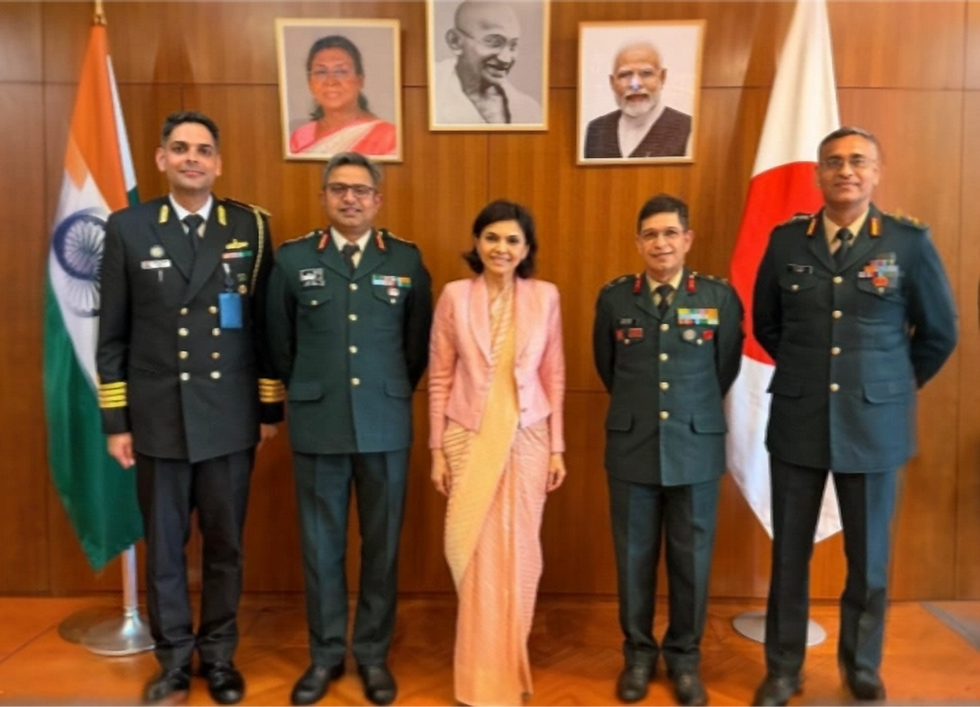
Key Outcomes of the 8th Army-to-Army Staff Talks
The talks brought together the Indian Army and Japan Ground Self-Defense Force (JGSDF) for three days of structured engagement. The delegation called on Nagma M Mallick, the Ambassador of India to Japan, and General ARAI Masayoshi, the Chief of Staff, JGSDF- bringing to light the diplomatic seriousness with which both sides regard the annual mechanism. The discussions focused on enhancing interoperability through increased bilateral exercises and Subject Matter Expert (SME) exchanges. Both sides also reviewed the ongoing progress of existing defense cooperation and mapped out future engagements across various domains.
Strengthening Indo-Pacific Security and FOIP Vision
Centrally, both armies reaffirmed their commitment to a free and open Indo-Pacific (FOIP)- the strategic vision that has become the defining feature of India-Japan security cooperation in recent years. FOIP, first articulated by Japan under Prime Minister Shinzo Abe, has become one of the central pillars in Tokyo’s foreign Policy posture, which has strongly resonated in India’s own Indo-Pacific posture. That both sides continue to invoke it at the operational level, not merely the diplomatic one, signals the degree to which the concept has been internalized across the bilateral security architecture.
Japan’s Defence Export Policy Shift: A Turning Point
The backdrop of Japan's revised three principles lends the talks added significance. Historically, Japan's self-imposed restrictions on defence exports severely constrained the scope of military technology-sharing with partners, including India. The new operational guidelines represent a substantive departure from that posture - one driven by Tokyo's recognition that a more permissive export framework is essential if Japan is to function as a credible security partner in an increasingly contested regional environment. India, as one of the world's largest defense importers (accounting for 8.2% of the global share) and a country actively pursuing domestic defense manufacturing under its Atmanirbhar Bharat initiative, stands to benefit considerably from this shift.

India’s Strategic Perspective and Policy Signals
India's Ministry of External Affairs made its appreciation explicit. Spokesperson Randhir Jaiswal, at the weekly media briefing, noted that defense and security cooperation constitutes an important pillar of the India-Japan Special Strategic and Global Partnership, and that both sides have committed under their Joint Declaration on Security Cooperation to increasing practical cooperation in the interest of national security and economic dynamism. The statement was notable for its directness- a signal that New Delhi sees Japan's policy evolution not merely as a bilateral opportunity but as a structural contribution to regional stability.

From Dialogue to Operational Cooperation
The AAST mechanism itself has grown steadily in substance since it was institutionalised as part of the expanding India-Japan defence dialogue. It complements other bilateral military engagement formats - including the Dharma Guardian joint army exercises and the broader framework of reciprocal logistical support agreements, and reflects a conscious effort by both sides to move beyond political declarations toward the harder, operational side of military-to-military integration.
Regional Reactions and Strategic Implications
Beijing has not remained silent. Chinese state media and analysts have urged India ‘not to forget history’ and resist what they describe as Japan's slide toward remilitarisation- framing Tokyo's revised arms export policy as a dangerous breach of its postwar pacifist order. The argument carries a certain irony that analysts across the region have noted: it is precisely China's sustained military expansion and assertive posture in the Indo-Pacific that has accelerated the security convergence Beijing now warns against. The argument, however, sits awkwardly alongside Beijing's own record of arms exports. According to SIPRI data, China supplied 80% of Pakistan's arms in the most recent five-year period, up from 73% previously, as Pakistani total arms imports surged 66%, making Islamabad the fifth-largest arms recipient globally. China ranked as the world's fifth-largest arms supplier, with Pakistan receiving 61% of its exports.
That Beijing, the region's most active arms proliferator, is cautioning New Delhi against welcoming Tokyo's loosened export guidelines is an irony that analysts across the region have been quick to note. Hence, India can't be swayed by such counsel, particularly as its own threat perceptions, such as the Pakistan-China strategic nexus, also shaped by the 2020 Galwan clashes and persistent border tensions with China, remain a primary driver of its own defence procurement and partnership calculus, and it continues to push New Delhi toward deeper partnerships with like-minded democracies.
India–Japan Partnership: From Alignment to Action
What the 8th AAST demonstrates, taken alongside Japan's revised arms transfer guidelines and India's enthusiastic response, is that the India-Japan defence relationship is entering a qualitatively new phase. The convergence of strategic interests, the alignment on Indo-Pacific norms and now the prospect of direct defence equipment cooperation suggests a partnership that is moving- carefully but unmistakably - from strategic alignment to practical, interoperable partnership.



Comments