


JICA’s Vision Beyond Connectivity: Transforming Northeast India’s Development

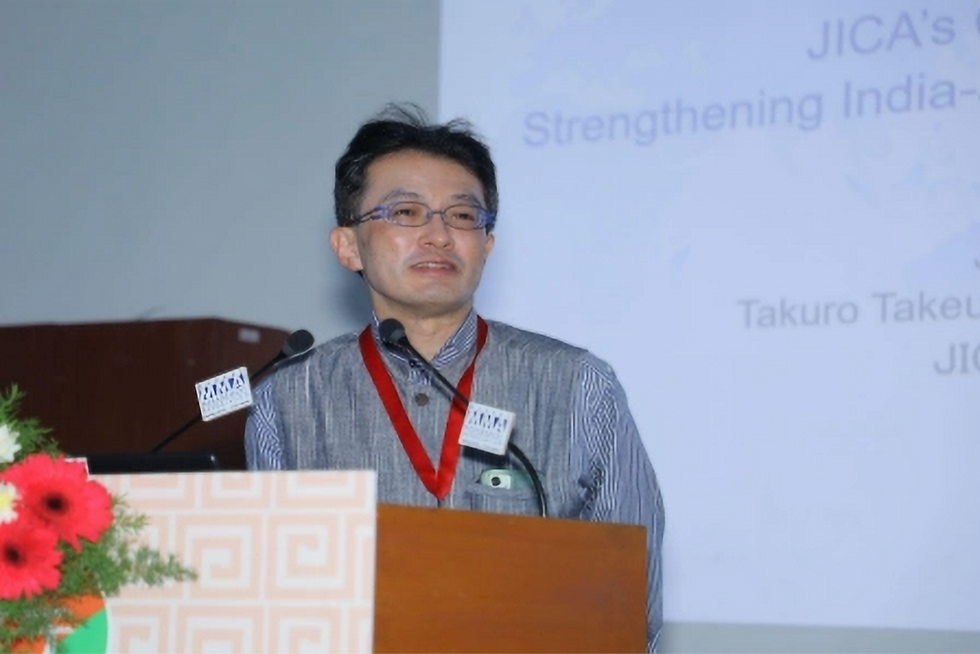
At the Kizuna 6 Conference in Shillong, Takuro Takeuchi, Chief Representative of the JICA India Office, highlighted a new chapter in Northeast India’s development. The region’s story, he noted, is no longer just about roads and bridges—it is about transforming connectivity into opportunity, resilience, and inclusive growth. For JICA, Northeast India is emerging as a strategic frontier for long-term development and regional cooperation.

When Takuro Takeuchi, Chief Representative of JICA India Office, addressed delegates at Kizuna 6 Conference , organised by Asian Confluence in Shillong, his message was clear: Northeast India's story is no longer just about roads and bridges. It is about building a development core — one that transforms connectivity into opportunity, resilience, and equity.
For the Japan International Cooperation Agency (JICA), Northeast India is not a peripheral geography. It is a strategic frontier — economically, geopolitically, and developmentally.
A 68-Year Japan–India Development Partnership
Japan and India share 68 years of development cooperation. As highlighted in the presentation, Japan has provided INR 4.9 trillion in Official Development Assistance (ODA) loans to India to date, making India one of the largest recipient of Japanese ODA globally . Today, more than 120 projects are underway across India under JICA's partnership framework.
Within that broader canvas, JICA Northeast India projects have gained special prominence. According to the presentation, JICA is currently cooperating on 20 projects in the Northeast, amounting to INR 23,529 crore, with connectivity as the centrepiece . But as Takeuchi emphasised, connectivity is only the beginning.
Rediscovering Northeast India's Potential
To understand the present, Takeuchi invited the audience to look back. Before Independence, Northeast India was far from isolated. It was an industrially vibrant region built on tea, jute, coal, oil, and limestone industries. A strategic transport corridor once linked production areas to ports through integrated road, rail, and river systems .
Then came 1947.
The partition of India severed critical transport links when Sylhet became part of East Pakistan, cutting the Northeast off from its traditional connectivity networks . Security instability from the 1950s onward further discouraged investment and diverted state attention toward law and order rather than economic growth.
For decades, the region remained economically marginalised.
A Turning Point: Security and Infrastructure
The last decade, however, has marked a decisive shift in Northeast India development.
Violent incidents have fallen by 71%, with an 82% reduction in civilian deaths by 2023 . Several peace accords — including Bodo (2020), Karbi (2021), Adivasi (2022), DNLA (2023), and UNLF (2023) — have reshaped the security landscape.
Simultaneously, infrastructure investment has accelerated:
Operational airports increased from 9 in 2014 to 17.
Nearly 10,000 km of national highways were built with about INR 1 lakh crore in central investment.
Railway expansion accelerated to 200 km per year.
Villages have been electrified and connected with broadband access .
The economic results are visible. In FY2023–24, seven of eight Northeast states outpaced India's national growth rate of 7.6%, with Assam (12%), Meghalaya (11.9%), and Nagaland and Mizoram (10.2%) posting double-digit growth .
The Northeast is no longer waiting for development. It is gradually taking off.
From Connectivity to CORE
Yet Takeuchi posed a crucial question: What comes after roads?
JICA's answer is encapsulated in the CORE framework — Connectivity, Opportunity, Resilience, and Equity .
Connectivity remains foundational. JICA has already helped complete 600 km of roads in Northeast India, with another 250 km under implementation . These projects under the JICA road connectivity project umbrella are critical for linking states internally and with neighbouring countries.
But connectivity alone does not guarantee prosperity.
Opportunity: Building Industry, Not Just Access
The next phase must focus on economic opportunity. Manufacturing accounts for 14% of India's GDP, but in most Northeast states (excluding Assam and Sikkim), the share ranges between 1% and 6% . The region contributes less than 2% of India's skilled workforce .
This imbalance reveals both a challenge and an opportunity.
JICA is now exploring cooperation on developing Assam's semiconductor ecosystem, leveraging Japan's expertise in semiconductor manufacturing and workforce systems . This signals a strategic pivot: from infrastructure building to industrial ecosystem creation.
For Japan ODA India cooperation, this marks a new chapter — one that aligns with India's ambitions in advanced manufacturing and trusted technology supply chains.
Resilience: Development That Endures
Economic growth without resilience is fragile. Northeast India falls into high-risk categories for landslides and earthquakes, according to Indian agencies .
Through projects such as the Meghalaya community-based forest management initiative, JICA supports watershed management, erosion control, and climate adaptation efforts . These interventions integrate environmental stewardship with livelihood improvement.
In a climate-vulnerable region, resilience is not optional — it is essential.
Equity: Strengthening Social Foundations
Years of underinvestment and mountainous terrain have left gaps in healthcare and social services. Several states lack full-time neurosurgeons, and 73% of non-communicable disease patients seek treatment outside their home states .
JICA's response has been concrete:
Nagaland's first tertiary-care medical facility.
Mizoram's first cancer hospital and medical college.
Super-speciality wings in six Assam medical colleges .
These projects are not merely infrastructure upgrades. They represent investments in human capital — the true foundation of sustainable Northeast India development.
Northeast as a Regional Core
Takeuchi concluded with a compelling vision: building "cores" of opportunity, resilience, and equity on top of connectivity will enable Northeast India to emerge as a regional core with its neighbours .
Geographically, the Northeast sits at the crossroads of South and Southeast Asia. Strategically, it can serve as a bridge between India and ASEAN economies. Economically, it holds untapped potential in natural resources, tourism, manufacturing, and green growth.
For JICA, the journey "beyond connectivity" reflects the broader philosophy of Japan–India cooperation: trust-based, long-term, and development-oriented.
As discussions at Kizuna 6 made clear, Northeast India's transformation is no longer a distant aspiration. It is underway. The challenge now is to ensure that new highways lead to industries, that growth withstands climate shocks, and that development uplifts communities across hills and valleys alike.


Comments