


The Andaman Prelude: The India-Japan-Indonesia Trilateral Naval Exercise

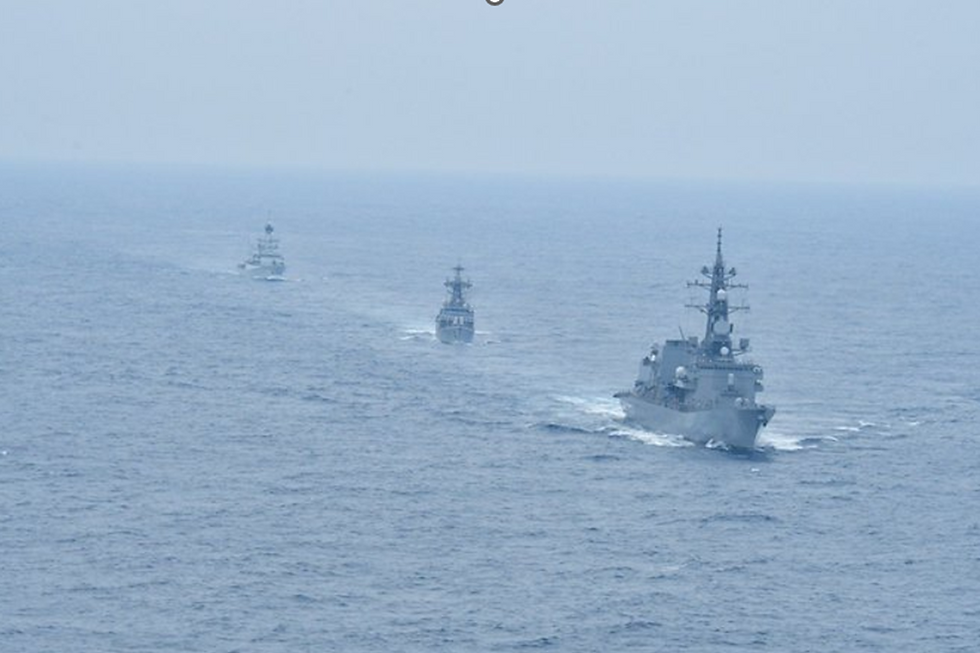
While the world’s eyes are fixed on the ongoing spectacle of MILAN 2026 (15-25 February) in Visakhapatnam, a much quieter, more pointed story played out on February 13th in the Andaman Sea- the naval exercise between India, Japan and Indonesia. This exercise, focused on increasing interoperability and operational readiness, reinforced maritime cooperation among the three nations. It was a calculated demonstration of a layered security architecture- the kind of functional, high-stakes partnership that actually is a step towards realizing the ‘3s’ of Indo-Pacific- stability, security and safety.
Through this drill in the Andaman Sea, New Delhi, Tokyo and Jakarta stood on the doorstep of the Malacca Strait. Being one of the world’s most vital Sea Lines of Communication and maritime chokepoints, Malacca is a literal central vein for global trade and energy (the shortest shipping route between East Asia and the Middle East and Europe; it accounts for 30% of global trade). In this context, for India, this maritime exercise represents one of the driving forces behind the MAHASAGAR vision (Mutual and Holistic Advancement for Security and Growth Across Regions). It moves the conversation beyond New Delhi simply acting as a Net Security Provider (a term that often feels paternalistic) to becoming a Preferred Security Partner in the region, aligning with India’s Act East Policy.
For Japan, the stakes are equally high. Tokyo sees this trilateral as a vital pillar of its "Free and Open Indo-Pacific" (FOIP) strategy. Also, by engaging with Indonesia, Japan is diversifying its security beyond the U.S. alliance. In efforts to ensure that Southeast Asian partners have the autonomy and the hardware to resist regional pressures, Japan here plays the role of an architect of the layered security model that bridges the Quad and ASEAN.
But for Indonesia, the stakes are more personal. With the ongoing negotiations for the acquisition of Italy’s ITS Giuseppe Garibaldi, Indonesia is moving closer to becoming the fourth Asian power to operate an aircraft carrier (after Japan, China and India). This highlights Jakarta’s ambition to support actors in the Indo-Pacific as potential leaders. By joining forces with carrier-operating powers like India and Japan, Jakarta is signalling that its "Minimum Essential Force (MEF)" is growing effectively.
Critics often dismiss carrier acquisitions by middle powers as prestige projects, particularly when the case in point is an archipelagic nation like Indonesia, a nation that is already experimenting with converting toll roads into emergency runways. However, seen through the lens of the Andaman trilateral, the Garibaldi represents something more than just a floating airfield. It is a command-and-control hub. Jakarta’s version of carrier operations will likely be more functional than expeditionary. By using the Garibaldi as a platform for helicopters, UAVs (like the Bayraktar TB3), Indonesia is trying to create a mobile base for High-Availability Disaster Recovery (HADR) as well as maritime surveillance. Ultimately, Indonesia is trying to balance both. Appearing as a significant and modern regional power while needing to protect thousands of islands on a developing nation's budget.
Overall, this naval engagement is a subtle but firm assertion. The gateway to the East will remain open, governed by rules and protected by the region’s most capable resident navies. Prime Minister Narendra Modi has designated 2026 as the ASEAN-India Year of Maritime Cooperation. This exercise gives that declaration teeth, which could have easily been just another diplomatic slogan. Indonesia, the traditional heavyweight of ASEAN, being included in this exercise shows that India is also effectively bridging the gap between the high-level strategic alignment of the Quad (represented here by Japan) and the practical, daily security needs of Southeast Asia. It creates a three-way security alignment on the regional stability of the Indo-Pacific.
What was witnessed in the Andaman Sea is the future of Indo-Pacific security. A future built through these overlapping circles of cooperation- smaller, agile groups of nations that have the skin in the game and the hardware to back it up. As these ships have now turned their bows toward the operations related to MILAN, the real takeaway is the quiet confidence shared between New Delhi, Tokyo and Jakarta.
About the Author
Kaveri Jain is a doctoral researcher in International Relations at the Amity Institute of International Studies, Amity University, Noida. Her work focuses on India-Japan relations during the Shinzo Abe era. She has presented at academic conferences, published in peer-reviewed platforms and written on various aspects of India-Japan ties, including foreign policy, technology cooperation, cultural exchange, diaspora diplomacy and engagement in the Indo-Pacific region.


Comments