


Indian Vice Chancellors’ Visit to Japan: Reorienting India-Japan Education Diplomacy

As global education pathways shift, a new destination is quietly capturing the imagination of Indian students. With Japan announcing scholarships to welcome 5,000 Indian students over the next three years, and senior Indian university leaders engaging directly with Japanese institutions, a subtle but significant realignment is underway. What is unfolding is not just a change in study destinations, but a deeper rebalancing of India–Japan educational and knowledge partnerships—one shaped by opportunity, strategy, and a shared Asian future.

As 2026 unfolds, a quiet yet seismic shift is occurring in the aspirations of Indian students. For decades, the compass of Indian higher education pointed unwaveringly West- toward the ivy-covered halls of the United States, the historic universities of the United Kingdom and the sunny campuses of Australia. However, as traditional destinations face new barriers, an important partner in the East is opening its doors wider than ever before. Japan’s latest initiative to attract 5,000 Indian students over the next three years by offering scholarships is not merely a recruitment drive.
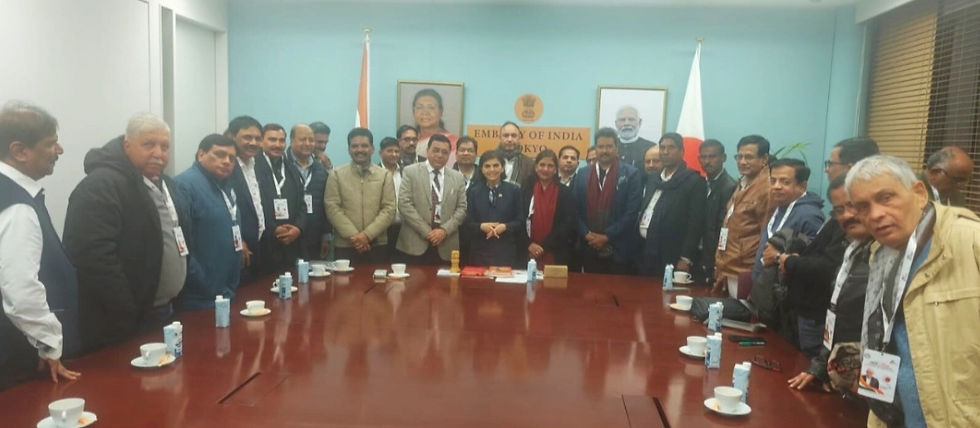
From January 12 to 17, a group of vice-chancellors from thirty Indian institutions, under the auspices of the Association of Indian Institutions (AIU), travelled to Japan to strengthen collaboration in higher education, research and innovation. The Ministry of Education, Culture, Sports, Science and Technology, as well as academic institutions like the University of Tokyo, were involved. This is one of the most important chapters in a century-long saga of intellectual and cultural diplomacy between two Asian giants.
The Historical Tapestry
To understand the significance of the current delegation to Tokyo, one must look back further than the recent economic partnerships. The educational bond between India and Japan is rooted in the early 20th-century Pan-Asianism fostered by Nobel laureate Rabindranath Tagore and Japanese art historian Okakura Tenshin. Their dialogue was about a shared Asian spiritual and cultural identity. Tagore’s visits to Japan and the establishment of the Japanese studies department at Visva-Bharati University (formally started in 1954, housed at Nippon Bhavan) planted seeds of mutual respect.
The real acceleration in “knowledge diplomacy” began in the 21st century. The collaboration to establish the Indian Institute of Technology (IIT) Hyderabad remains a crowning jewel of this era. IIT Hyderabad’s campus architecture and academic ethos were deeply influenced by Japanese collaboration, symbolizing a shift from mere financial aid to structural and intellectual partnership.
The New Initiative: Bridging the Language Divide
The recent visit by the Association of Indian Universities (AIU) delegation to Japan, concluding on 17 January 2026, marks a pivotal moment. The delegation, in collaboration with Acumen, held productive meetings with the University of Tokyo and the Japan External Trade Organization (JETRO) on 13 January 2026. The discussions focused on strengthening academia-industry linkages and advancing collaboration in research. This reflected a shared vision for innovation-driven higher education. The target set by Tokyo, an intake of 5,000 students from India over three years, is ambitious but strategic. Historically, the Japanese language has been the single biggest deterrent for Indian students, who naturally gravitate towards English-speaking nations.

The delegation also met the Indian Ambassador to Japan, Nagma Mohamed Mallick, with discussions being focused on academic cooperation, student and faculty exchanges, research collaborations and joint degree opportunities in order to strengthen the global footprint of Indian higher education. The Indian Vice Chancellors also met the Kyoto University of Advanced Studies (KUAS) on 15 January 2026. Their discussions here centred on research, innovation and long-term institutional partnerships to strengthen global knowledge exchange and academic excellence.
On 16 January 2026, the Indian VCs held a productive interactive session with Professor Tomoyuki Takashi (President of Kansai University and Dean international of Kansai University), focusing on strengthening India-Japan academic collaboration. New opportunities in research, innovation and long-term institutional partnerships were also explored. They also held an interaction with Mr. Chandru Appar (Consul General of India, Osaka-Kobe), who shared valuable insights on strengthening university-to-university cooperation between India and Japan. A MoU was also signed between AIU, Acumen and Kansai University, paving the way for deeper academic cooperation between higher education institutions of both nations. This visit also included cultural events showcasing Japan’s heritage to foster stronger people-to-people connections, moving beyond academic engagements.

The new policy explicitly dismantles this barrier. As a senior educationist from the delegation noted, “The first year of any degree would be held in English, with international students taught Japanese to ensure they are fluent in it.” This approach is a game-changer. It acknowledges the reality of the global education market while preserving the cultural integration necessary for long-term employment in Japan. Furthermore, the initiative is reciprocal. Japan has committed to sending its own students to India, not just for technical education but to immerse themselves in India’s “soft power” assets, such as Yoga and spiritualism, alongside STEM subjects. This two-way exchange, fostering faculty mobility and joint research, indicates a relationship of equals.
The Geopolitical Context: The West Closes, the East Opens
The timing of Japan’s outreach is impeccable. The global landscape for Indian students has darkened significantly in the last twelve months. The traditional “Big Three”- the US, UK and Australia- have all tightened their borders in response to domestic housing crises and migration debates.
Australia’s recent move to classify India as a "high-risk" category for student visas has sent shockwaves through the applicant pool. Similarly, the UK’s crackdown on dependents and the rising financial thresholds for visas have made British education increasingly inaccessible for the Indian middle class. Amid visa crackdown, Indian student enrolment in US universities has led to a 75% drop. Canada, once an option for thousands of students, has capped international student permits, leaving a massive vacuum in the market.
In this context, Japan’s offer is not just an alternative. It is a lifeline. Japan faces an acute demographic crisis with an aging population and a shrinking workforce. It needs young, skilled talent to sustain its economy. India, with the world's largest youth population (the demographic dividend), faces the opposite problem: a surplus of talent seeking quality education and employment. The synergy is undeniable. When the Japanese delegation speaks of "offering jobs to students who have graduated from India," they are addressing their own labour shortage as much as India’s employment needs.
Conclusion: A Strategic Realignment
This initiative is clearly more than a scholarship scheme. It is a strategic realignment. By targeting the “language barrier” and offering a clear pathway from classroom to corporate Japan, Tokyo is positioning itself as a viable competitor to the West. The spirit of Tagore and Okakura lives on, updated for a world where software engineering and nursing have replaced poetry and philosophy as the currency of connection.

About the Author
Kaveri Jain is a doctoral researcher in International Relations at the Amity Institute of International Studies, Amity University, Noida. Her work focuses on India-Japan relations during the Shinzo Abe era. She has presented at academic conferences, published in peer-reviewed platforms and written on various aspects of India-Japan ties, including foreign policy, technology cooperation, cultural exchange, diaspora diplomacy and engagement in the Indo-Pacific region.


Comments