


Rabindranath Tagore and Japan: The Civilizational Dialogue That Shaped Asia's Modern Imagination

When Tagore looked at Japan, he recognised what colonised Asia desperately longed for: confidence without imitation and modernity wearing an unmistakably Asian face. But it was Japan's cultural poise that fascinated him more than its factories, institutions or military ascent.
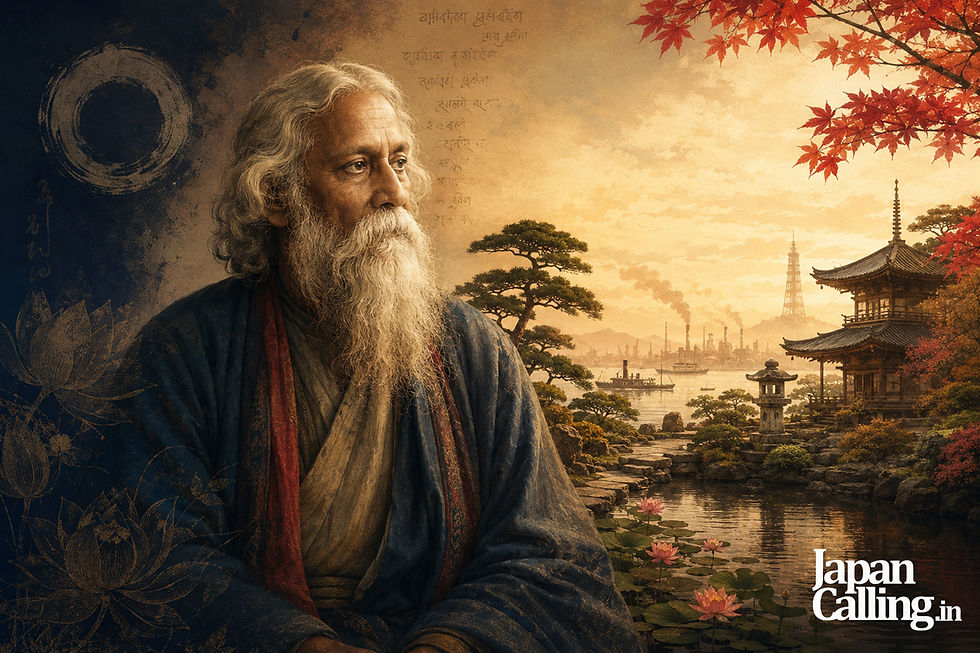
In the salt-washed quiet of Yokohama’s Sankeien gardens, where lotus blooms met sea winds, Rabindranath Tagore encountered not merely Japan, but Asia’s untapped potential to define the centuries to come.
The year was 1916. From the Shofukaku residence overlooking water, gardens and pine-shadowed stillness, the poet watched a landscape shaped by restraint, asymmetry and cultivated beauty. Out of that atmosphere emerged lines that would travel across languages and generations: “Stray birds of summer come to my window to sing and fly away…”
The poem was not merely a skilful accidental souvenir of travel. Stray Birds, written around the period of Tagore’s Japanese journey, carries unmistakable traces of Japanese aesthetic influence. Its compressed lyricism, its devotion to clouds, blossoms, leaves, birds and fleeting beauty, seem to converse quietly with Japanese artistic sensibilities.
Japan gave Tagore something larger than poetic imagery. It compelled the Indian philosopher to think, and left him with a question that would haunt his vision of Asia’s destiny: could an Oriental nation modernise without surrendering its cultural soul?
Across his visits in 1916, 1924 and 1929, Tagore did not approach Japan as a curious tourist or distant admirer; instead, he treated it as a historical experiment. Perhaps even a warning.
The Asian Confidence That Captivated a Colonised World
To understand Tagore’s fascination with Japan, we must recover how Japan appeared to Asia in the early twentieth century. After the Meiji transformation and the stunning defeat of Russia in 1905, Japan had emerged as a civilizational shockwave. Much of colonised Asia looked eastward with astonishment, because there was finally an Asian nation industrialising, modernising and competing with the West without formally becoming Western.
When Tagore looked at Japan, he recognised what colonised Asia desperately longed for: confidence without imitation, refinement without apology, modernity wearing an unmistakably Asian face. Yet it was Japan's cultural poise that fascinated him more than its factories, institutions or military ascent.
In Japan, beauty did not seem confined to museums or rarefied salons. It breathed through ordinary life. Craftsmanship, architecture, gardens, discipline and aesthetic sensibility moved in quiet harmony with modern development. Daily existence itself appeared touched by artistic intention.

During his stay at Sankeien as the guest of silk merchant and arts patron Tomitaro Hara, arranged through artist Yokoyama Taikan, Tagore immersed himself in that environment. Lotus ponds reminded him of India, and seasonal rhythms resonated with his own poetic imagination.
He spoke admiringly of Japan’s sensitivity to “the language of lines and music of colours”, its capacity to perceive beauty in irregularity, movement and impermanence. Tagore’s admiration for Japan extended beyond its cultivated elegance or aesthetic discipline.
He feared that modern civilisation was drifting toward efficiency without depth, progress without inner life. Japan appeared, at least initially, to offer a different civilizational script, one where machines and modernity did not extinguish beauty, and where technology and artistic sensibility could inhabit the same cultural imagination.
The Warning Hidden Inside the Admiration
Rabindranath Tagore and Japan's admiration was enough to honour its brilliance, and genuinely enough to challenge it when he sensed it drifting from its ethical moorings. That rare combination of admiration, concern and civilizational candour is what makes his relationship with Japan strikingly relevant even today.
His first visit came at a time when Japanese nationalism was growing sharper, more assertive and infused with imperial ambition. Across Asia, many continued to view Japan’s ascent with admiration and romantic enthusiasm. Tagore, however, possessed the farsightedness to discern something unsettling beneath the triumph, a civilisation in danger of mistaking power for purpose.

In lectures delivered during his Japanese tour, including India and Japan, The Message of India to Japan and The Spirit of Japan, he warned against the mechanised nationalism then reshaping Europe and spreading outward through imperial power.
At Keio University, Tagore cautioned against the cultivation of superiority and moral indifference in the pursuit of national power and wealth. His warning continues to echo across history’s long corridors. Civilisations have mastered industry, technology and statecraft before. Many still mistook power for permanence and found themselves biting the dust.
For Tagore, nationalism severed from ethical responsibility became dangerous not because nations should lack ambition, but because power without moral imagination corrodes civilisation from within.
Tagore feared that Japan, Asia’s most promising answer to the question of non-Western modernity, might end up wearing the armour of the very imperial nationalism it once appeared ready to outgrow. It is this friction between admiration and unease that gives his Japanese engagement an enduring and unsettling relevance.
.
A Partnership Larger Than Diplomacy
Tagore’s vision of India and Japan never rested on narrow calculations of state interest. He imagined a civilizational partnership grounded in culture, education, artistic exchange and shared responsibility toward Asia’s intellectual future.
India and Japan, in his mind, possessed complementary inheritances.
India could contribute philosophical inquiry, universalist reflection and traditions of spiritual and ethical thought. Japan could offer discipline, artistic sophistication and a compelling example of cultural self-confidence under modern conditions.
Tagore spent his Japanese visits addressing remarkably varied audiences. Politicians, artists, educators, journalists, students, women’s groups and intellectual circles packed lecture halls. His themes stretched from education and science to childhood, women’s development, international relations and Asia’s future. Such breadth reflected his deeper intellectual project. He was not merely speaking about Japan but was using it as a mirror through which Asia might interrogate its own destiny.
Tagore believed Japan was a civilisation destined for a larger calling than becoming an Asian echo of European imperialism.
Bringing India to Japan Without an Embassy

Long before cultural diplomacy acquired bureaucratic vocabulary, Tagore was already practising it. He helped bring India to Japan through translation, conversation and intellectual exchange.
He introduced Japanese audiences to Indian philosophical traditions, literary imagination and educational experimentation. Yet one small episode reveals his method more powerfully than any formal lecture.
During his first Japanese visit, Tagore recognised that colonial English could not fully sustain the kind of Asian dialogue he wished to cultivate. He therefore delivered one of his addresses in Bangla, later translated into Japanese by Rikhang Kimura.
The significance of this choice extends beyond language as it was a subtle yet deliberate refusal of colonial linguistic hierarchy. The exchange no longer depended upon imperial mediation and became an experiment in civilizational reciprocity, an Indian language speaking directly to a Japanese one. The same philosophical impulse would come to animate Santiniketan.
Today, India–Japan ties are often narrated through bullet trains, semiconductor cooperation, infrastructure investment, Indo-Pacific strategy, supply-chain resilience and the Quad. Those dimensions matter deeply. But decades before the contemporary strategic partnership acquired institutional form, Santiniketan functioned as a proto-cultural diplomacy platform.
Japanese artists, scholars and pan-Asian thinkers moved through Tagore’s educational world, and Japanese artistic influences left a visible imprint on Santiniketan’s visual culture and pedagogy. These encounters shaped more than institutions or artistic practice. They helped forge the grammar of a civilizational dialogue through which Asia sought to imagine how it might think together.
The Poet Behind the Partnership

The Yokohama skyline has changed since Tagore gazed across sea and garden from Shofukaku. Earthquakes altered the physical landscape, and modernity redrew horizons, but the questions he carried to Japan remain unsettlingly alive.
Modern India–Japan relations are discussed through economics and geopolitics. Governments speak of resilient supply chains, maritime strategy, advanced manufacturing and strategic balancing in the Indo-Pacific.
But Tagore’s story reminds us that India and Japan possess a relationship older than contemporary geopolitics and deeper than transactional partnership. Before policy frameworks, there was an intellectual exchange unfolding through gardens, lecture halls, classrooms and artistic networks.
Relationships built only on interests can survive summits, negotiations and strategic recalculations. Relationships animated by civilizational curiosity can outlive governments and even history’s upheavals.
Tagore predicted that Asia’s future would not be shaped by power alone, nor merely by trade routes or military conquests. It would depend on what its civilisations chose to preserve about beauty, ethical responsibility, cultural confidence and the moral purpose of modernity.


Comments